Livestream marketing works when you combine a clear message, the right channel, and an interactive format both before, during, and after the broadcast. Start marketing at least four weeks before the event: launch a YouTube or Facebook ad campaign and involve thematic influencers who share the content with their audience. For a greater reach and a more relaxed schedule, ideally start six to eight weeks before; for a smaller event, four weeks is enough. The rest is planning.
- Message before transfer: confirm what the viewer gets and why it is unique
- Channels: YouTube, Facebook, Instagram, email and partners together
- Ticket sales: Piletilevi or Piletimaailm + early bird discount
- During the transfer: moderated Q&A, live polls and timed offers
- After: highlights, catch-up and analytics
Professional advice: Checklist and technical support are available via Television.ee — live broadcast production It always starts with preparation and a test protocol, not with turning on the camera.
Main conclusions
Livestream marketing succeeds when the message, channel and technique work together and marketing begins at least four weeks before the event; for larger or international projects, it is recommended to start six to eight weeks in advance.
| Point | Details |
|---|---|
| Start marketing early | Launch the advertising campaign at least four weeks before the event, not a week before. |
| Ticket sales need active promotion | Listing on Piletilevi or Piletimaailm does not sell tickets by itself — marketing must ensure its discoverability. |
| Involve influencers and fans | Niche influencers increase trust and conversion better than brand advertising alone. |
| Carry out a technical test 72 hours in advance | Tests 72h, 24h and 1h before the transfer prevent most errors that would otherwise cost the most. |
| Television as a full service | Television provides production, a platform, LED screens and self-generated electricity all over Estonia. |
Contents
- Why live-stream marketing impacts ticket sales and reach?
- How to set goals, KPIs and know your target audience?
- What should the action plan be before, during and after the transfer?
- Which channels and tactics should be used to promote a livestream?
- How to organise ticket sales and monetisation in Estonia?
- How to keep viewers engaged during a broadcast?
- What should be checked technically before the transfer?
- Which metrics should be monitored and how to reuse the content?
- What do Estonian practitioners say about live-stream marketing?
- What Television has seen: common mistakes and how to avoid them
- Television provides a full service for live broadcast production
- Sources
Why live-stream marketing impacts ticket sales and reach?
Many organisers worry that a live broadcast will cannibalise on-site ticket sales. This fear is understandable, but rarely justified if the local experience is richer than the broadcast. You cannot feel the roar of engines through a screen. You cannot exchange thoughts with a speaker during the coffee break from your sofa at home. When the on-site experience is clearly superior, the two do not compete with each other.
What a live broadcast definitely does is expand the audience. Estonians who are currently in London, Helsinki or Tokyo can follow the event. In the case of an English-language event, a global audience opens up. This is new revenue, not a redistribution of old revenue.
A well-planned event creates a suitable environment for delivering the message And event marketing success depends on preliminary work and the creation of emotions. A live broadcast is one channel for fulfilling this goal, not a replacement.
- Local audience: on-site experience + broadcast complement each other
- Remote viewer: pays for a ticket that otherwise wouldn't have been sold
- International audience: English-language event reaches globally
How to set goals, KPIs and know your target audience?
Before you launch any ads, answer one question: what is considered a success? The success of video marketing depends on who and what kind of content is produced for — the strategy must be based on the objective, not just the technology.
Types of objectives and suitable KPIs:
- Brand awareness: unique views, reach, video watch time
- Ticket sales: online conversion rate, CPA (cost per ticket), number of tickets sold
- Lead generation: number of registrations, email subscribers, B2B contacts
- Value of sponsors: logo visibility, brand mentions, viewer demographics report
Target audience personas at a glance:
- Local audience in Estonia: aware of the event, needs a reminder and early bird discount
- Remote viewer/professional: searches online, needs a clear value proposition and a simple purchasing process
- International viewer: found through a YouTube or Facebook ad, requires English content
What should the action plan be before, during and after the transfer?
Good live event marketing combines target audience, channel selection, message, timing and the booking experience — and if the marketing works well, the registration journey must be ready for increased traffic.
- 6–8 weeks before: confirm the message, open ticket sales in Piletilevi or Piletimaailm, finalise influencer contracts, launch teaser content
- 2–4 weeks before: launch paid advertising on YouTube and Facebook, send an email campaign, activate partners
- 48–72 hours before: run a technical rehearsal, send the reminders, post „taking place tomorrow“ content
- Event date: check all connections, assign a moderator, launch the holding page, monitor traffic in real time
- After the transfer: cut highlight clips within 24 hours, process leads, send a thank-you letter, analyse KPIs
| Faas | Action | Responsible person |
|---|---|---|
| 6–8 weeks before | Message, ticketing, influencers | Organiser + marketer |
| 2–4 weeks before | Paid advertising, email, partners | Marketer |
| 48 to 72 hours before | Technical rehearsal, reminders | Technician + marketer |
| Event day | Moderation, traffic management | Team together |
| After | Clip, analytics, remarketing | Marketer |
Which channels and tactics should be used to promote a livestream?
YouTube is best suited when you want SEO reach and post-viewing. YouTube Live helps you reach new audiences and enables both public and private streaming. Facebook works well through communities and event pages, and Instagram's Stories and Reels are ideal for short teasers. Instagram's visual strategy significantly influences engagement — random content doesn't work.
Many social media campaigns fail because the message misses the mark. Plan each channel separately, rather than copying the same post everywhere.
| Channel | Best format | Organic vs paid |
|---|---|---|
| YouTube | Teaser, trailer, review | Both |
| Event page, short clips, advertisement | Both | |
| Stories, Reels, countdown | Predominantly organic | |
| Reminder, early bird discount | Organic |
Involving influencers noticeably increases trust and ticket conversion. Choose thematic influencers rather than simply the accounts with the largest following. Content shared by fans and attendees is often more trustworthy than the brand's own advertising. A good example of how a short clip works as an advertisement is
. When setting up paid advertising on Facebook and Instagram, it is worth checking out With Facebook and Instagram advertising strategies.
How to organise ticket sales and monetisation in Estonia?
The success of live stream ticket sales depends above all on how well its existence is introduced to the audience. A ticket that no one knows can be bought will remain unsold.
- Piletilevi is Estonia's largest ticketing platform, featuring a broad user base and a familiar purchasing experience
- Piletimaailm it is an alternative that is particularly well-suited for smaller and niche events
- Early bird discount (e.g. 20–30% at a reduced price during the first week) boosts sales and creates social proof
- VIP access With catch-up viewing, it bundles two products into one: the on-site experience + the digital archive
- Corporate season tickets suitable for conferences and training sessions where one decision-maker purchases multiple seats
- Sponsorship packages Together with logo visibility in the broadcast, there is a separate revenue stream that many organisers underestimate
How to keep viewers engaged during a broadcast?
Estonians are modest — guided activities that initiate interaction work better than open „write in the comments“ calls to action. Moderated panel discussions and targeted polls give the viewer a clear role.
- Q&A sessions: Gather the questions in advance and answer the selected questions during the broadcast.
- Live polls: use the platform's polling feature or Mentimeter for live voting
- Scheduled offers: „For the next 15 minutes, you can get ticket 15% at a lower price“ creates a sense of urgency
- Exclusive discount codes: exclusive to stream viewers, shared in the chat at a specific moment
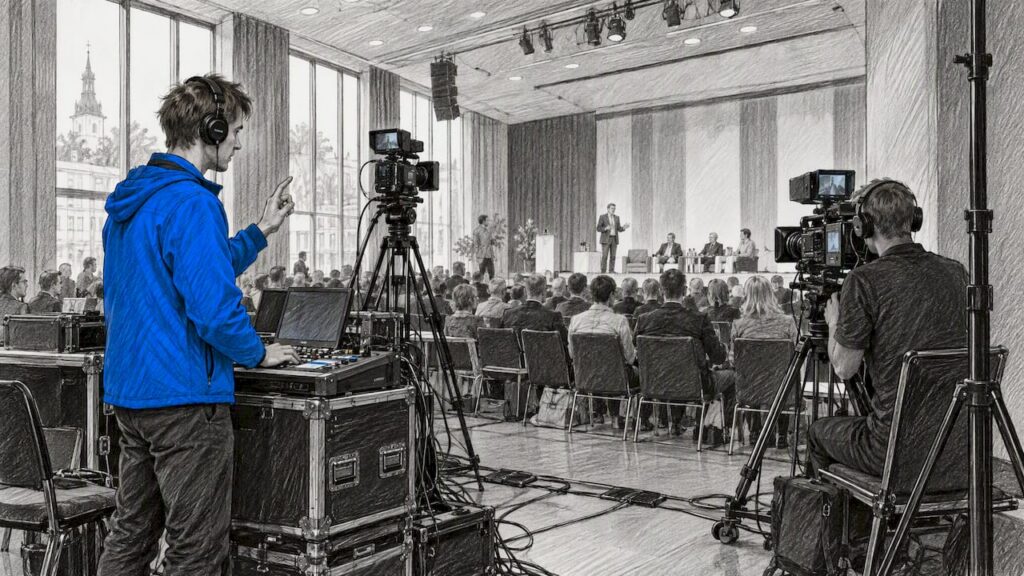
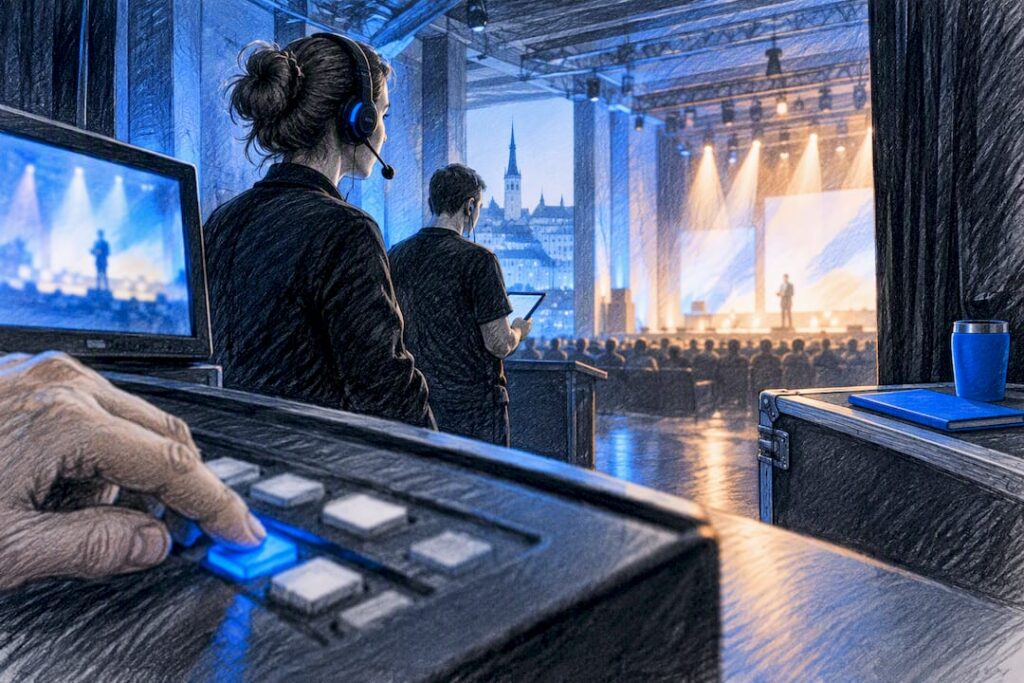
The team needs three roles: a live moderator (monitors the chat and Q&A), technical support (monitors the video and audio), and a social media manager (posts real-time clips and responds to comments).
What should be checked technically before the transfer?
Technical preparation starts much earlier than one hour before — it's like motorsport, where the one who has practised the most wins.
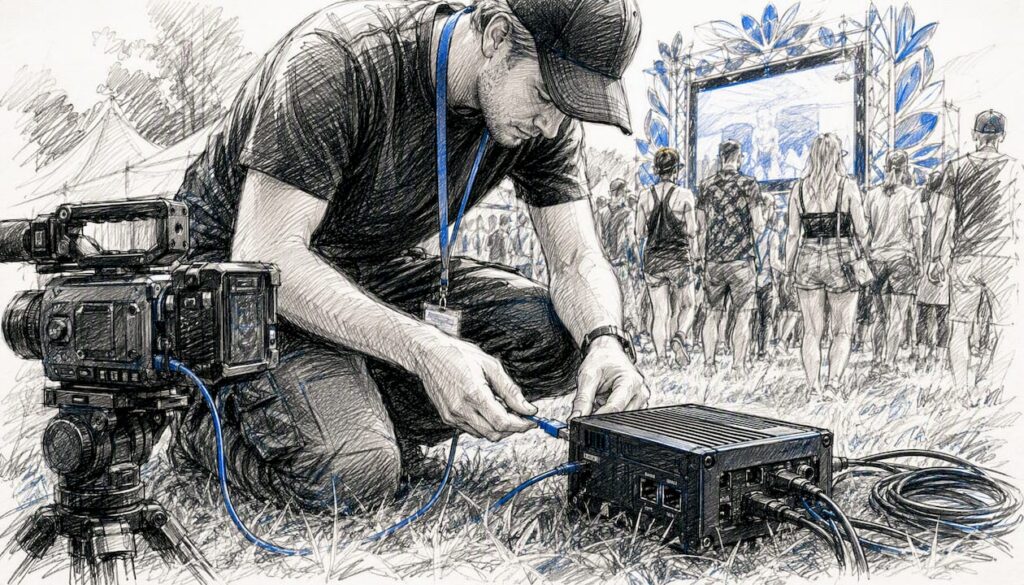
- 72 hours before: test the entire chain from the camera to the platform, check the internet upload speed (minimum 10 Mbit/s stable upload)
- 24 hours before: synchronise audio-video tests, secure the backup camera and backup network connection, check the recording settings
- 1 hour ago: run a full rehearsal, check graphics and title display, confirm team roles and contacts
Contingency plans not to forget:
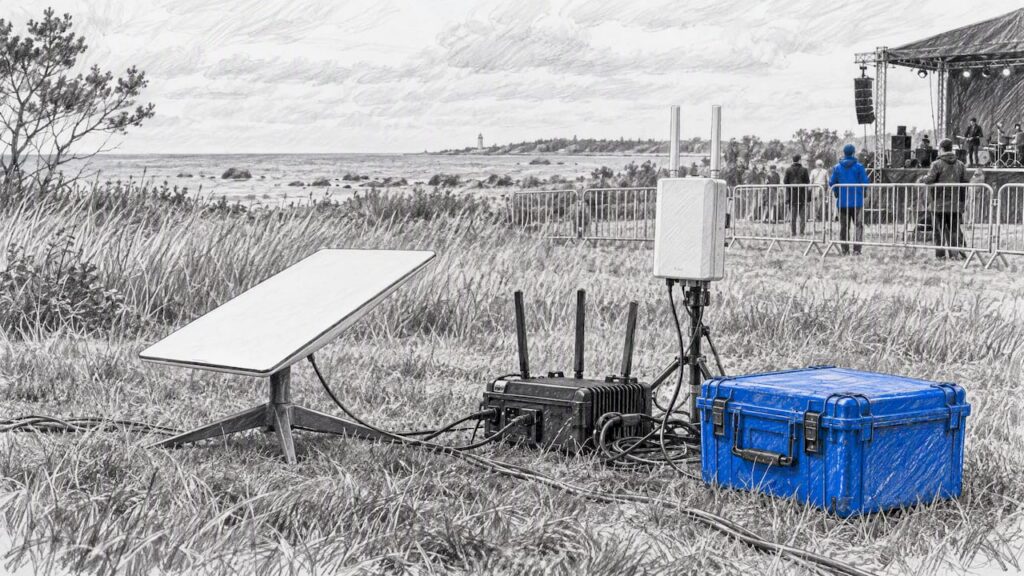
- Generator or Television.ee local electricity in places where the grid connection is unstable
- Alternative streaming platform if the main one fails
- Reversing camera and backup computer that is on all the time
Professional advice: When ordering the technical solution for the conference Always ask who is responsible for each technical element — diffusion of responsibility is the most common cause of failure.
Which metrics should be monitored and how to reuse the content?
Marketers need to acquire new analytics tools, to measure the true impact of campaigns. Numbers to track:
- Viewership and unique views (YouTube Analytics, Facebook Insights)
- Average watch time: A score below 30% indicates that the content does not hold the reader’s attention
- Ticket conversion: how many viewers bought a ticket after seeing the advertisement
- Paid advertising CPA: cost per ticket sold
- Number of catch-up views within the first 48 hours
Highlight clips are the cheapest way to extend the marketing life of an event. Cut 60 to 90-second clips of the best moments, add subtitles (most are viewed with the sound off) and share them across all channels. One well-made clip can bring in more registrations for the next event than an entire advertising campaign.
What do Estonian practitioners say about live-stream marketing?
„An event is a means to achieve a goal. Organisers must invest in gathering input information and fostering a positive participatory attitude — without a clear goal, it is difficult to achieve the desired results with either technology or marketing.
— Olavi Ruhno, WOW Events (Ärileht)
Both quotes point to the same thing: technique is the means, the message is the goal. Organizers who start with the question „what does the viewer get?“ sell more tickets than those who start with the question „what camera should we use?“.
What Television has seen: common mistakes and how to avoid them
For over 10 years, we have been producing top-level live broadcasts and have anticipated most of the mistakes. Here are the ones that happen most frequently.
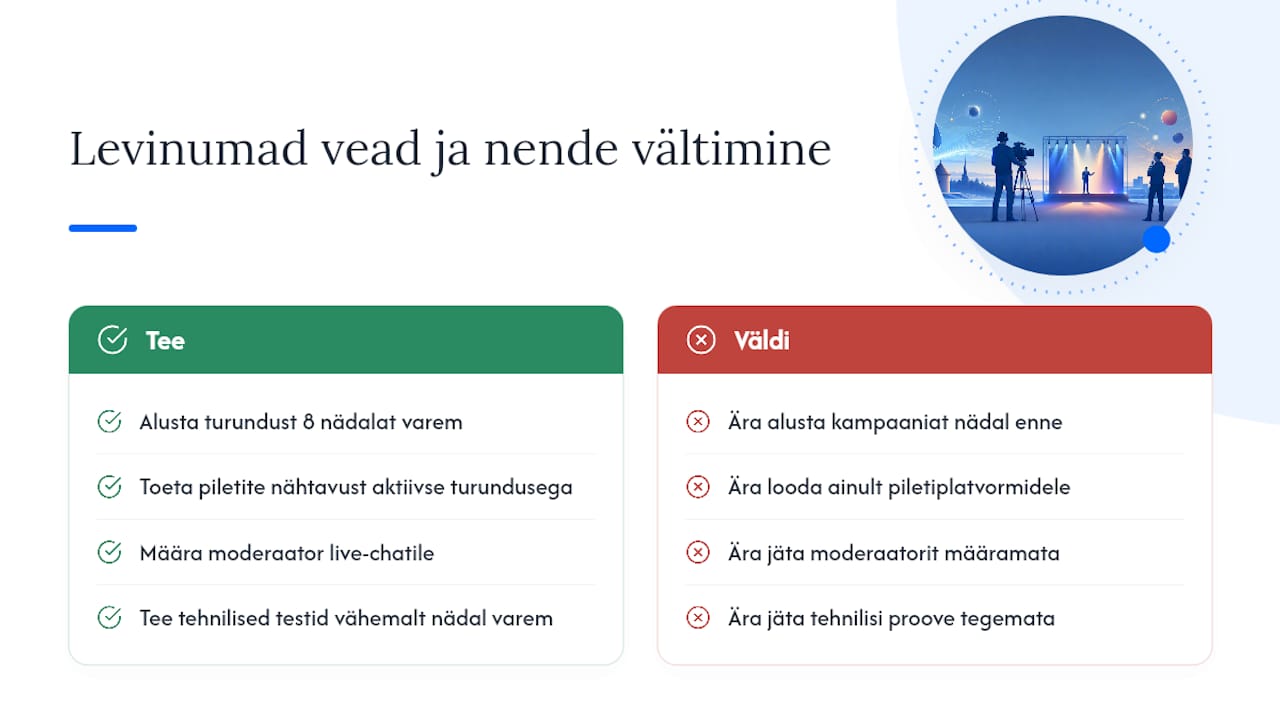
High-end marketing Number one. A campaign that starts a week before the event will not reach the algorithms or people's consciousness. For a marketing campaign, four weeks is the minimum, while eight weeks is ideal to reach both the algorithms and people's consciousness.
Defective hybrid ticketing strategy it means that the livestream ticket exists, but nobody knows about it. Piletilevi and Piletimaailm help distribute it, but marketing must actively support its discoverability.
Lack of a moderator turns live chat into chaos or silence. Neither helps sell.
Failure to perform technical tests is the most expensive mistake. A problem discovered one hour before the event costs ten times more than the same problem a week earlier.
Television approaches every project with a technical rehearsal, self-generated electricity in locations where the grid is unreliable, and logistics planning that also accounts for the environmental footprint. Lower fuel consumption, fewer single-use materials, more reusable equipment. If the internal team can cover all of the above themselves, that is brilliant. If not, bringing in a full service is cheaper than fixing one major mistake.
Television provides a full service for live broadcast production
If you have an event, but no team, equipment or time to organise everything yourself, Television is the partner that is large enough to ensure quality, and attentive enough to care about the details.
We offer a complete solution: production from any location, streaming platform accommodation, mobile LED screens across Estonia, operators and, if necessary, on-site electricity in locations where infrastructure is lacking. A date, location, purpose and expectations are all we need. We take care of the rest. Start from the live broadcast production page and get in touch — the first consultation is free.
Sources
- How does event marketing fulfil your goals? – Ärileht
- Members“ Morning Webinar ”Video Marketing in Digital Channels" – E-Commerce Association
- Visual Instagram marketing of beverage brands: graduation thesis – TalTech
- Marketing in the age of artificial intelligence – University of Tartu
- Reach new audiences through YouTube live streaming – Callbridge
- 5 mistakes in a social media marketing campaign – Veebispetsid
- Top Live event marketing strategy tips – Queue-Fair
-