In brief:
- To organise a professional live broadcast, a local full-service partner is required who offers a team and a hosted platform. Browser-based tools are only suitable for smaller podcasts, not larger events.
If you are organising a conference, sports event or product launch with real viewers and real stakes, the short answer is: choose a local full-service partner who provides both an on-site team and a hosted platform. Browser-based tools are good for podcasters and small-scale streamers, but for a professional event, they fall short.
Why this choice reduces risks:
- The on-site team ensures equipment compatibility: the camera frame rate, LED screen refresh rate, and encoder settings must all match each other.
- A backup connection (such as cellular data or multiple ISPs) is planned in advance, not improvised.
- Local Estonian support means that in the event of a problem you do not wait for hours of English-language chat.
- Documented test plans and pre-event rehearsals are what separate the professional from the amateur.
Professional advice: Always ask the service provider: „What happens if the internet goes down?“ If the answer is „let's hope it doesn't“ — keep looking.
First steps: check the provider's experience (10+ years is a good sign), ask for an SLA and backup connection solution, and send a quotation request with a specific date and expected number of viewers. Live stream production You can get a quote for this quickly from Television.ee.
Contents
- What do StreamYard and Restream not offer for full-service production?
- How does the user interface affect the management of live broadcasts?
- What is the customer support like if something goes wrong?
- What legal requirements must be taken into account in Estonia?
- Are there examples of professional events in Estonia?
- How many viewers can the platform serve at once?
- Main conclusions
- What I have learned after ten years of live broadcasting
- Television offers a comprehensive solution that keeps working even when things go wrong
- Useful resources and checklists
What do StreamYard and Restream not offer for full-service production?
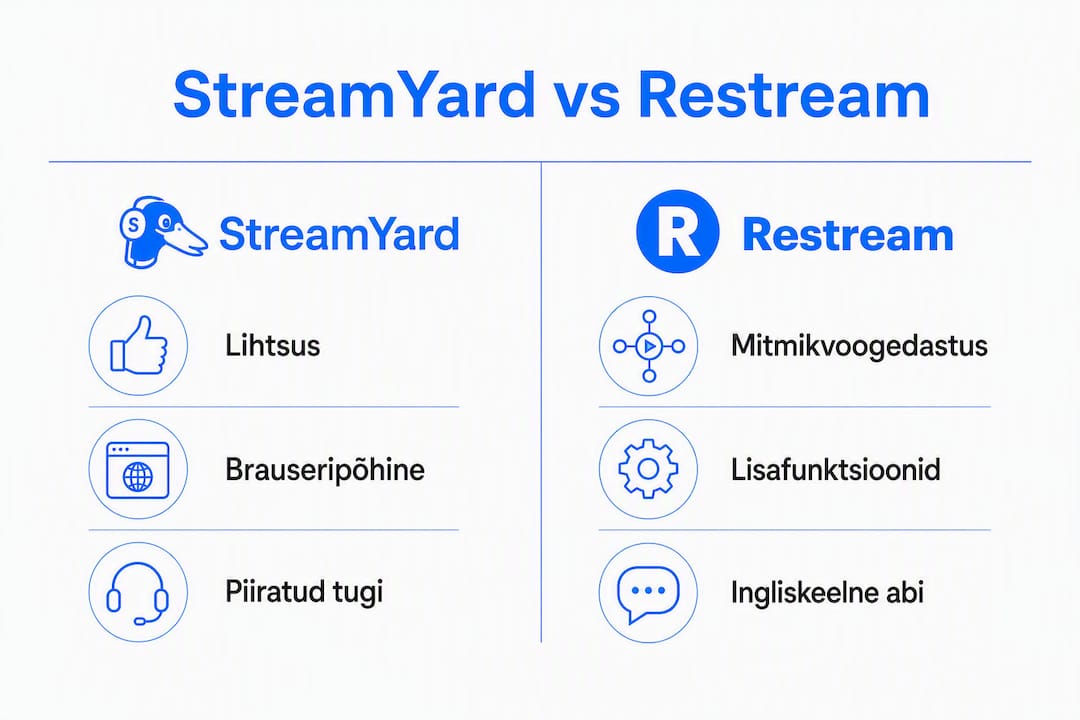
StreamYard and Restream are browser-based multi-streaming tools supported by an active community such as Join the Streamers’ Convoy – Nexly Connect for professional multi-streaming. They’re designed so that a single person can easily send their content to YouTube, Facebook and elsewhere all at once. That’s a big deal if you’re producing a weekly podcast. For a professional event, it’s a different story.
Both platforms offer a simple web studio and multi-channel broadcasting, but they lack control over hosting, payments and higher-level production. More specifically:
| Property | A browser-based tool | Full service (e.g. Television) |
|---|---|---|
| On-site team | No | Cast and crew (producer, camera operators, sound) |
| Hosted platform + VOD | Restricted | Yes, including analytics and ticket sales |
| Backup connection and SLA | No | Yes, documented |
| Integration of an LED screen | No | Jah |
| Estonian support | No | Jah |
When an event’s budget and reputation are at stake, a browser-based solution is like hiring a car in a foreign city without a map. You’ll manage, but stress is guaranteed.
How does the user interface affect the management of live broadcasts?
StreamYard is known for its simplicity: everything takes place in the browser, and adding elements is intuitive. Restream adds simpler analytics on top of multi-streaming. Both are suitable for a single person running the entire show by themselves.
However, a professional event has at least three roles: a producer (manages the content), a technical director (monitors the signal and encoders) and an operator (camera and audio). A browser-based tool is not designed for such team collaboration. If something goes wrong, a single person cannot manage the camera, audio mixer and streaming settings all at once.
What is the customer support like if something goes wrong?
StreamYard and Restream mainly offer English-language email and chat support. Response times can vary from hours to days. During a live stream, this is too slow.
With a local partner, the technical manager is on site. Problems are resolved in minutes, not hours. It’s a difference you only really appreciate when something actually goes wrong.
What legal requirements must be taken into account in Estonia?
In Estonia, the GDPR applies to the protection of personal data, which means that audience data (including email addresses from ticket sales) must be processed in accordance with the regulation. If you use a third-party platform whose servers are located outside the EU, you must check the data processing agreement. A locally hosted platform makes this much simpler.
You must also take copyright into account: background music, logos and third-party content require permission. This applies regardless of which platform you use.
This is general information, not legal advice. For specific questions, consult a lawyer.
Are there examples of professional events in Estonia?
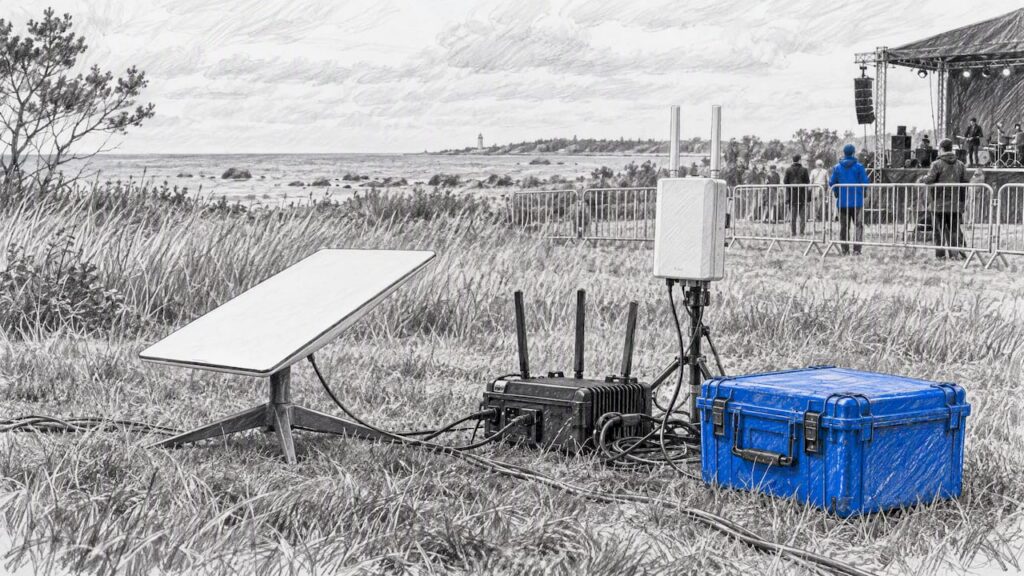
Television has produced live broadcasts of sports events, conferences and product launches across Estonia, including in locations where infrastructure is completely lacking. TV production of the European Orienteering Championships in Rakvere Here is an example where the local team, backup connection and test plan worked together to get the job done.
How many viewers can the platform serve at once?
Browser-based tools forward the stream to YouTube or Facebook, where a third party is responsible for scalability. If the platform is your own (or hosted by a partner), scalability is controlled by the hosting agreement. Television.ee streaming platform built for professional needs, supporting a large simultaneous audience alongside VOD delivery and analytics.
Experience from sports events shows that scalability and viewer volume management requires prior planning, not the hope that the platform will „somehow manage“.
Main conclusions
For a professional event in Estonia, a local full-service partner with a hosted platform is clearly a stronger choice than a standalone browser-based tool.
| Point | Details |
|---|---|
| Full service vs DIY tool | Browser-based tools are suitable for podcasts, not professional events. |
| The on-site team is mandatory | The producer, technical director and camera operators must be present, not on screen. |
| Backup connection and SLA | Always ask for a documented backup plan, not a verbal promise. |
| GDPR and data processing | Local hosting simplifies compliance with EU data protection requirements. |
| Television.ee | Offers on-site production, hosted platform, VOD and LED screen rental across Estonia. |
What I have learned after ten years of live broadcasting
The most common mistake event organisers make is choosing a platform before deciding who is responsible. A tool will not solve the problem if no one knows what to do if the internet cuts out ten minutes before the start.
Browser-based solutions have made streaming accessible, and that is a good thing. But they have also created the illusion that professional live streaming is simply a matter of „press a button and that's it“. In reality, it is more like conducting an orchestra: everyone has their own role, rehearsals have been done, and the conductor knows exactly what happens if someone plays a false note.
When it comes to events in Estonia, there is another layer: local conditions, communication in Estonian, and the fact that help must arrive in minutes, not hours. That cannot be bought with a monthly package.
Television offers a comprehensive solution that keeps working even when things go wrong
You have just read why browser-based tools fall short for a professional event. Television.ee is the local partner who arrives with a team, sets everything up in advance, conducts rehearsals and takes responsibility for the result from start to finish. We produce our own electricity, optimise logistics and work even in locations where there is no infrastructure at all.
The service includes an on-site producer, a technical director, camera and sound operators, a hosted platform with VOD and analytics, and if necessary LED screen hire. Pricing is project-based: daily rate, additional fees for transport and power supply in locations without infrastructure.
Request a quote with a specific date and event description: live stream production or operator rental.
Useful resources and checklists
The following sources will help you draw up a procurement document or a technical specification list:
| Source | What do you find there |
|---|---|
| How to plan a live-stream event – The Art Neon | Roles and responsibilities, incident plan, rehearsal checklist |
| LED screen planning – KAWDEN | Refresh rate and camera compatibility requirements |
| Live streaming and recording service – Vanglaplaneet | Stages of the production process and delivery terms |
| LED video wall rental guide – REISSOPTO | Technical specifications for the screen, as per the tender documentation |
| Television.ee blog | Practical tips, test examples and production stories |
Professional advice: Always copy specific technical requirements into the procurement document: frame rate, resolution, backup connection SLA, VOD delivery deadline, and file formats. A general „live broadcast“ is not a sufficient description.